You Won’t Believe These Oslo Landmarks – My Honest Tips
If you’re heading to Oslo, forget everything you thought you knew about Nordic cities. This place isn’t just fjords and snow—it’s a bold mix of sleek modern design and rich history hiding in plain sight. I was blown away by how much character its landmark buildings pack into such a compact city. From a futuristic opera house that invites you to walk its roof to a castle with centuries of royal secrets, Oslo’s architecture tells stories you can’t afford to miss. Here’s how to truly experience them.
Arriving in Oslo: First Impressions of a City That Blends Old and New
As your plane descends toward Oslo, the city unfolds beneath you like a quiet revelation. Nestled between forested hills and the glistening Oslofjord, the capital presents a skyline that defies expectations. There are no towering skyscrapers or dense urban sprawl. Instead, low-rise buildings with clean lines and thoughtful spacing dominate the view, many with green roofs or surrounded by parks. This is a city designed with breathing room, where nature isn’t an afterthought—it’s woven into the urban fabric.
First-time visitors often expect Oslo to be reserved, even austere, in line with Nordic stereotypes. But the reality is quite different. The city pulses with quiet innovation, particularly in its architecture. Each major landmark feels like a conversation between past and future—one that values transparency, sustainability, and accessibility. This unique blend didn’t happen by accident. After devastating fires in the 17th century and periods of reconstruction in the 19th and 20th centuries, Oslo had the rare opportunity to rebuild with intention. Urban planners prioritized walkability, public access, and environmental harmony, shaping a cityscape that feels both grounded and forward-looking.
What’s striking is how seamlessly the old and new coexist. You might walk past a 12th-century church and turn the corner to face a glass-and-steel cultural center. This architectural dialogue invites deeper exploration. It’s not just about aesthetics; it reflects Norway’s values—democracy, openness, and respect for both heritage and progress. For travelers, this means every neighborhood offers a layered experience, where design isn’t just seen but felt. The city’s compact size makes it easy to witness this evolution on foot, turning a simple stroll into a journey through time and vision.
The Opera House: Where Design Meets Public Access
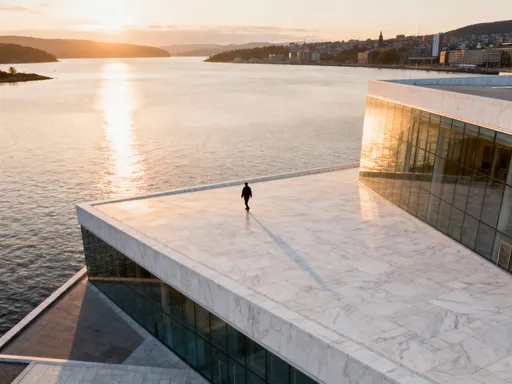
Rising from the waterfront like a glacier carved by human hands, the Oslo Opera House is one of the most photographed landmarks in Norway—and for good reason. Completed in 2008, this architectural marvel is clad in white Italian marble and Portuguese limestone, its sloping roof extending from the ground upward at a gentle incline. What makes it truly unique is that visitors are not only allowed but encouraged to walk on its roof. This bold design choice transforms the building from a distant monument into a living part of the city.
Walking the roof of the Opera House is an experience that stays with you. As you ascend the gently rising marble surface, the city falls away behind you. To the left, the Oslofjord stretches toward the horizon, its waters shimmering in summer or frozen in winter. To the right, the modern skyline of Bjørvika emerges, with its glass towers and cultural institutions. At the top, 15 meters above ground, you’re rewarded with a panoramic view that captures the essence of Oslo—water, forest, and urban life in perfect balance. I visited at sunset, when golden light bathed the marble and the sky turned soft pink. Standing there, it was easy to understand why locals call this spot their ‘public living room.’
But the Opera House is more than a visual spectacle. It’s a statement about accessibility and inclusion. In a country that values equality, the idea that a world-class cultural venue should be physically and symbolically open to all makes perfect sense. The interior houses multiple performance halls, hosting opera, ballet, and concerts, yet the building’s true magic lies in its invitation to participation. Whether you’re attending a show or simply walking the roof, you’re part of the experience. For visitors, this means no barriers—literally or figuratively. The Opera House embodies a philosophy that culture belongs to everyone, and its design ensures that message is felt before it’s even heard.
Oslo City Hall: A Democratic Masterpiece You Can’t Skip
No visit to Oslo is complete without stepping inside Oslo City Hall, a red-brick masterpiece that stands proudly on the eastern edge of the waterfront. Built in the mid-20th century, this building is more than just a seat of local government—it’s a symbol of Norwegian democracy and civic pride. Its twin towers rise above the harbor, and its grand halls host one of the most prestigious events in the world: the Nobel Peace Prize ceremony every December. Knowing that history unfolds within these walls adds a quiet reverence to every step you take inside.
The true heart of City Hall lies in its interior murals. Created by some of Norway’s most respected artists, these large-scale works depict scenes from the nation’s history, folklore, and social values. One mural shows fishermen braving the North Sea, another illustrates the signing of Norway’s constitution in 1814. The art is bold, expressive, and deeply human, celebrating labor, unity, and peace. Walking through the main assembly hall, you can’t help but feel the weight of collective ideals. The space is used year-round for city meetings, exhibitions, and public events, reinforcing its role as a living institution rather than a ceremonial relic.
For travelers, the best way to experience City Hall is through one of its free guided tours, offered in English during peak seasons. These 45-minute walks provide insight into the building’s architecture, art, and political significance. Even outside tour hours, visitors can explore the ground floor and the Nobel Peace Center, which offers interactive exhibits about past laureates and global peace efforts. The surrounding area is equally worth your time. A waterfront promenade leads to Aker Brygge, a lively district with restaurants and shops, while the nearby ferry terminal offers routes to islands in the Oslofjord. Visiting in the morning ensures smaller crowds and better lighting for photography, especially when the sun hits the brick façade just right.
Akershus Fortress: History Standing Strong on the Waterfront
Perched on a rocky promontory overlooking the Oslofjord, Akershus Fortress has stood as a sentinel of the city for over 700 years. Originally built in the late 13th century by King Haakon V, its thick stone walls and strategic position were designed to protect Oslo from sea attacks. Over the centuries, it evolved from a medieval castle into a military stronghold, later serving as a prison and even a Nazi headquarters during World War II. Today, it’s a cultural site managed by the Norwegian Armed Forces, open to the public and deeply embedded in the city’s identity.
Walking through the fortress grounds feels like stepping into layers of history. Stone archways, iron gates, and cobblestone paths lead you through courtyards and defensive towers. One of the most powerful experiences is walking the ramparts, where you can look down at the original harbor defenses and imagine the clang of swords or the roar of cannons. From this vantage point, the modern city spreads out in contrast—glass buildings, sailboats, and pedestrians moving freely. The juxtaposition is striking: a place once built for war now stands as a monument to peace and resilience.
Accessibility has been carefully considered. The site is mostly flat, with paved paths suitable for strollers and wheelchairs. During the summer months, from May to September, guided tours are available in English, offering deeper insight into the fortress’s military and royal past. While the interior halls are not always open, the exterior grounds are free to explore year-round, making it a perfect stop at any time of day. Families enjoy the open space, while history enthusiasts appreciate the informational plaques and preserved artifacts. What’s especially meaningful is how Akershus connects to modern Oslo—not as a relic, but as a living part of civic life. Military ceremonies still take place here, and it’s a popular spot for locals to jog, picnic, or simply enjoy the view. This continuity between past and present is what makes the fortress so powerful.
The Munch Museum: A Bold Tribute to Norway’s Most Famous Artist
In 2021, Oslo welcomed a striking new addition to its cultural landscape—the Munch Museum at Tøyen. Replacing the older, more cramped location, this modern building features a jagged, angular façade of dark brick and glass, designed to evoke emotion even before you step inside. It’s a fitting tribute to Edvard Munch, the artist behind *The Scream* and one of Norway’s most influential cultural figures. With over 26,000 works in its collection, including paintings, drawings, and prints, the museum offers an immersive journey through Munch’s turbulent mind and artistic evolution.
Seeing *The Scream* in person is a moment few forget. The version housed here—one of four created by Munch—is displayed in a dedicated room with controlled lighting and climate. The colors—fiery orange sky, dark blue water, the ghostly figure with hands clasped to its face—feel more intense in real life than in any reproduction. The museum uses space and lighting to amplify the emotional weight of the piece, surrounding it with silence and shadow. Nearby galleries trace Munch’s exploration of anxiety, love, death, and nature, showing how he turned personal suffering into universal art. It’s not always easy to look at, but it’s impossible to look away.
To make the most of your visit, consider renting the audio guide, which provides context for key works and shares quotes from Munch’s journals. The museum is designed as a non-linear experience, allowing visitors to follow thematic paths rather than a fixed timeline. This encourages personal connection—perhaps you’ll be drawn to his depictions of the Norwegian coast, or his portraits of women, or his experimental print techniques. The building itself enhances the experience, with wide corridors, natural light, and quiet contemplation zones. For a more peaceful visit, arrive early in the day or on a weekday. The on-site café, located on the top floor, offers panoramic views of the city and a chance to reflect after viewing such intense art. Whether you’re an art lover or simply curious, the Munch Museum challenges you to feel deeply—and that’s exactly what Munch intended.
Deichman Bjørvika Library: A Quiet Revolution in Urban Design
In a city that values knowledge and community, the Deichman Bjørvika Library stands as a quiet revolution in public space. Located just across from the Opera House, this pyramid-shaped wooden structure is both modern and warm, its layered façade resembling stacked books or mountain terraces. Opened in 2021, it’s Oslo’s new main library and a model of sustainable design. But more than that, it’s a vibrant social hub where reading, learning, and connection come together in unexpected ways.
Step inside, and you’ll find an open-concept interior flooded with natural light. There are no strict silence rules—just zones of varying noise levels, from quiet reading nooks to collaborative workspaces. The ground floor hosts events, exhibitions, and a café, while upper levels offer book collections, study rooms, and children’s areas. One of the most popular features is the ‘idea lab,’ where visitors can use 3D printers, recording equipment, or VR technology. This isn’t a library frozen in time; it’s a living institution adapting to modern needs. For families, there’s a dedicated children’s floor with interactive displays and storytelling corners. For students and remote workers, there are comfortable seats with power outlets and fast Wi-Fi.
What makes Deichman special is how it invites lingering. You don’t have to check out a book to belong here. People come to read, work, meet friends, or simply enjoy the view of the fjord through floor-to-ceiling windows. The rooftop terrace is a hidden gem, especially in summer, offering a peaceful spot for a coffee or quiet reflection. For photographers, the interior’s geometric design and wooden textures create stunning visual opportunities. The best times to visit are weekday mornings for peace, or late afternoons for people-watching and golden-hour light. In a world where public spaces are often commercialized, Deichman reminds us that cities need places that are free, inclusive, and intellectually nourishing. It’s not just a library—it’s a statement about what a city owes its people.
Planning Your Visit: Smart Moves for Seeing Oslo’s Icons Without Stress
One of Oslo’s greatest advantages for travelers is its walkability and efficient public transit. Most of the landmarks discussed here are clustered in the Bjørvika and city center areas, making it easy to explore several in a single day. A smart itinerary might begin with the Opera House in the morning, followed by a walk to the Deichman Library, then lunch at Aker Brygge before heading to City Hall and Akershus Fortress. The Munch Museum, located slightly inland, can be reached by a short metro ride on Line 4 or 5 from Jernbanetorget station.
Public transportation in Oslo is reliable, clean, and well-marked in English. The Ruter app is essential for planning routes and purchasing tickets. Trams, buses, and ferries are all part of the same system, and a 24-hour travel pass offers excellent value. Walking is equally rewarding—paths along the waterfront connect major sites and offer constant views of the fjord. Comfortable shoes are a must, as Oslo’s terrain includes gentle slopes and cobblestones.
Seasonal timing also plays a role in your experience. Summer, from June to August, offers long daylight hours—sometimes up to 18 hours of sunlight—making it ideal for outdoor exploration. The city comes alive with festivals, outdoor cafés, and boat tours. Winter, from December to February, brings a different magic. Shorter days mean buildings are illuminated with warm lighting, and the snow-covered Opera House roof looks like a scene from a fairy tale. Indoor sites like the Munch Museum and City Hall are especially welcoming during colder months. Regardless of season, layering clothing is wise, as coastal weather can shift quickly. Finally, consider visiting popular sites early in the day to avoid crowds, and always check official websites for updated opening hours and special events.
Final Thoughts: Why Oslo’s Architecture Stays With You
After spending time in Oslo, you begin to notice a pattern: its architecture doesn’t shout, but it speaks deeply. Whether it’s the sloping roof of the Opera House, the hand-painted murals of City Hall, or the quiet warmth of the Deichman Library, each landmark reflects a commitment to human-centered design. These buildings aren’t just beautiful—they’re thoughtful. They invite interaction, respect history, and prioritize accessibility. In a world where cities often feel impersonal, Oslo offers a refreshing alternative: one where form and function coexist with kindness and intention.
What lingers isn’t just the postcard views, but the details. The way sunlight hits the marble steps just so. The sound of pages turning in a public library. The cold stone of a medieval fortress under your fingertips. These sensory moments create a deeper connection, reminding us that travel is about more than checking sights off a list. It’s about feeling present, noticing nuance, and allowing a place to leave its mark on you.
Oslo rewards curiosity. It invites you to look beyond the surface, to walk the roof, to enter the fortress, to sit quietly in the library. It doesn’t demand attention—it earns it. So when you visit, take your time. Let the city unfold at its own pace. Look up, look closely, and let yourself be surprised. Because the landmarks of Oslo aren’t just structures of stone and steel—they’re stories waiting to be lived.